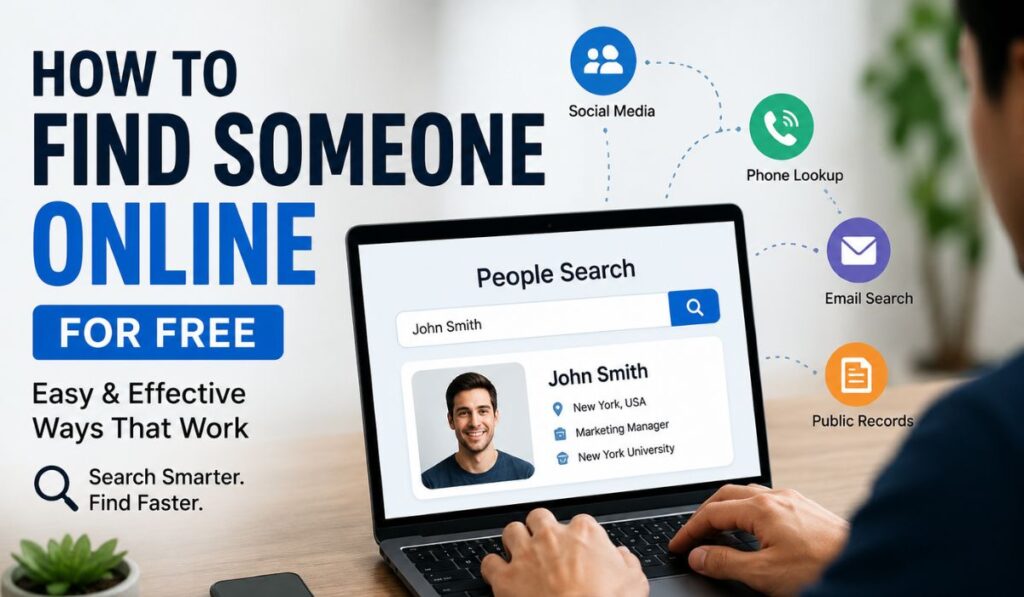
Finding someone online has become much easier than it was a few years ago. Whether you are trying to reconnect with an old friend, locate a relative, verify someone’s identity, or perform a basic online safety check, there are many free methods available that can help. The internet stores a large amount of publicly accessible information, and when used correctly, it can provide useful clues that help identify or reconnect with a person.
Many people think they need paid tools or advanced software to locate someone online. In reality, even a small amount of information such as a name, phone number, email address, username, or previous location can become a useful starting point. The key is understanding where to search and how to combine information from different sources.
In this guide, you will learn practical and legal ways to find someone online for free while respecting privacy and using publicly available information responsibly.
Why People Search for Someone Online
People search for others online for many different reasons. Some individuals want to reconnect with childhood friends or former classmates. Others may be searching for relatives they have lost contact with over time. Some people perform online searches to verify someone’s identity before meeting them in person, while others simply want to confirm publicly available information for personal safety.
For example, imagine that you are trying to find a friend from college named Michael. You remember that he moved to another state several years ago, but you only remember his old email address and a rough idea of where he worked. Instead of randomly searching through thousands of results, a structured approach can save time and produce more accurate results.
Start With Search Engines First
The simplest place to begin is usually a search engine. Search engines can collect information from websites, social profiles, public records, business listings, forums, and many other online sources.
Start by searching for the person’s full name. If the name is common, add more details that may narrow the results. Information such as a city, workplace, school, profession, or age range can help reduce unrelated matches.
For example, instead of searching only:
John Smith
you could search:
John Smith Texas architect
or:
John Smith Chicago University
Adding more identifiers often improves the chances of finding the correct person.
You can also place quotation marks around a full name to search for exact matches. Search engines sometimes display cached pages, images, and profile information that may provide additional clues.
Use Social Media Platforms for Better Results
Social media websites have become one of the easiest ways to locate people online. Many individuals actively share information about their work, education, hobbies, interests, and locations through public profiles.
Platforms like Facebook, Instagram, LinkedIn, X, and other social websites often contain useful information that helps identify someone correctly.
LinkedIn is particularly useful if you know where the person works or their profession. If you are looking for a former colleague, classmate, or business contact, LinkedIn filters can narrow results based on location, company, industry, and educational background.
Facebook and Instagram may also reveal useful public information such as hometowns, family members, photos, and shared interests.
Sometimes people use the same username across several websites. If you know a username such as “michael1988,” try searching it directly online. Many users reuse usernames across social networks, gaming communities, forums, blogs, and other platforms. A single username can sometimes lead to multiple connected accounts.
Try Free People Search Websites
People search websites gather publicly available information from multiple sources and organize it into searchable databases. These websites may combine names, addresses, phone numbers, age ranges, possible relatives, and publicly available records into a single report.
If you decide to use a people search tool, start with whatever information you already know. Even small details can help improve search accuracy.
Useful starting information may include a full name, city, state, phone number, email address, username, or approximate age.
People search websites can sometimes help connect scattered pieces of information together. However, users should remember that free databases occasionally contain outdated records because information changes over time.
Use Reverse Phone Lookup When You Only Have a Number
Reverse phone lookup can be helpful if the only information available is a phone number. This method is commonly used to identify unknown callers, verify contact details, reconnect with someone, or perform basic safety checks.
For example, imagine you receive repeated calls from a number that you do not recognize. Instead of ignoring it, you may search the number to see whether public information connects it to a person or organization.
Reverse phone searches sometimes provide information such as a possible name, location, or other publicly available details. However, mobile numbers frequently change ownership, so information should always be verified before making assumptions.
Search Using an Email Address
Email addresses can also provide useful information when trying to find someone online. People often use the same email account across websites, social media platforms, and online communities.
You can search an email address directly using quotation marks.
For example:
Sometimes search results reveal profile pages, forum comments, social accounts, websites, or public references connected to that email.
Email searches can be useful when reconnecting with friends, verifying identities, or finding professional contacts.
Public Records Can Provide Additional Information
Public records are another useful resource during people searches. Depending on local laws and regulations, certain records may be available online.
Public information may include property ownership records, business registrations, court records, marriage information, or other legally accessible documents.
Availability differs depending on the location and government policies. Some public databases offer free access, while others may require registration or fees.
Public records work best when combined with other search methods because they can help verify existing information.
Address Lookup Can Help Connect Missing Details
Address searches can sometimes reveal useful clues if you have an old address connected to the person you are trying to locate.
For example, imagine you remember where someone lived years ago but cannot remember much else. Searching a historical address may help identify ownership records or related information that connects the address to the individual.
Address information should be used responsibly and only for legitimate purposes.
Verify Information Before Assuming Results Are Correct
One of the biggest mistakes people make when searching online is assuming the first result must be correct.
Common names can create confusion because many people may share identical names. Someone named James Johnson, for example, could generate hundreds or even thousands of results.
Before concluding that you found the correct person, compare multiple pieces of information. Verify details such as age, city, occupation, schools attended, family members, and social profiles.
The more matching details you have, the higher the confidence in your results.
Common Mistakes During Online People Searches
Many people search only using a person’s name and stop when they do not find immediate results. Others trust a single website without verifying information elsewhere.
Ignoring older information is another common mistake. Previous workplaces, schools, usernames, and addresses often become important clues during searches.
Another issue is relying on outdated databases. Information changes constantly, and records may not always remain current.
Using multiple methods together generally produces better results than depending on only one source.
Privacy and Legal Considerations
While finding someone online can be useful, privacy should always remain important. Public information does not automatically mean unrestricted use.
People search methods should never be used for harassment, stalking, identity theft, or any activity that violates privacy laws.
Always use publicly available information responsibly and ensure your search purpose is legitimate and ethical.
Conclusion
Learning how to find someone online for free is mostly about knowing where to start and combining different sources of information. Search engines, social media platforms, reverse phone lookup tools, email searches, public records, and address searches can all contribute useful information.
The most effective searches usually happen when several small details are combined together. Always verify results carefully and use information responsibly.
Disclaimer:
“This information is for educational and informational purposes only. Always comply with applicable privacy laws and regulations when searching for public information.”
Frequently Asked Questions
1. Can I find someone online for free?
Yes. Search engines, social media websites, public records, and people search tools can provide useful information at no cost.
2. What is the easiest way to find someone online?
Starting with a full name and city through search engines and social media platforms is often the easiest approach.
3. Can I find someone using only a phone number?
Yes. Reverse phone lookup can sometimes identify publicly available details connected to a phone number.
4. Does email lookup work?
Email lookup may help identify social accounts, forums, websites, and public profiles associated with an email address.
5. Are people search websites accurate?
Accuracy varies because information can change frequently.
6. Can I find old friends online?
Yes. Combining people search tools, social media searches, and public information can help reconnect with old friends.
7. Can usernames help find someone?
Yes. Many people reuse usernames across different platforms.
8. Are public records free?
Some public records are free, while others require payment or registration.
9. Is searching for someone online legal?
Generally yes, if you use publicly available information and follow privacy laws.
10. How do I confirm that I found the correct person?
Compare multiple identifiers such as location, family connections, age, and occupation.

I am Sandy Saga, a digital researcher and content specialist focused on people search, public records, online identity research, and data transparency. Through SearchPeopleFree.us, I create detailed guides, comparisons, and educational content to help readers better understand name searches, reverse email lookups, phone searches, address records, and public information discovery.
My goal is to make online information easier to understand by publishing practical, research-driven, and user-focused content that prioritizes clarity and responsible data usage.
I regularly explore trends in digital identity, search technologies, consumer privacy, and public data accessibility to provide readers with reliable and informative resources.
Expertise: People Search • Reverse Email Lookup • Phone Lookup • Address Search • Public Records • Online Research • Digital Identity